Max Loss Management: When to Take the Loss and Move On
In the dynamic world of options trading, the pursuit of profit often overshadows the critical importance of capital preservation. While every trader dreams of hitting a multi-bagger, the reality is that losses are an inevitable part of the game.
Abstract
In the dynamic world of options trading, the pursuit of profit often overshadows the critical importance of capital preservation. While every trader dreams of hitting a multi-bagger, the reality is that losses are an inevitable part of the game.
In the dynamic world of options trading, the pursuit of profit often overshadows the critical importance of capital preservation. While every trader dreams of hitting a multi-bagger, the reality is that losses are an inevitable part of the game.
The true differentiator between consistent profitability and eventual ruin isn't the ability to pick winners every time, but rather the discipline to manage losers effectively. At Volatility Anomaly, we consistently emphasize that options risk management is not just a theoretical concept; it's the bedrock upon which all sustainable trading careers are built.
This article delves deep into one of the most crucial, yet often neglected, aspects of options trading: defining and executing your maximum loss strategy. We're not just talking about theoretical limits; we're talking about actionable rules, such as cutting losses at a predefined multiple of the credit received for credit spreads, or implementing a clear options stop loss for debit strategies.
We will explore the psychological hurdles that prevent traders from taking losses, the mathematical imperative behind early exits, and provide concrete examples using real market data and popular tickers like SPY and QQQ. Our goal is to equip you with the knowledge and discipline to answer the perennial question: "When do I take the loss and move on?"
By establishing clear, objective rules for your iron condor max loss, credit spread adjustments, or any options strategy, you can transform potential catastrophic drawdowns into manageable setbacks, preserving your capital for the next high-probability opportunity.
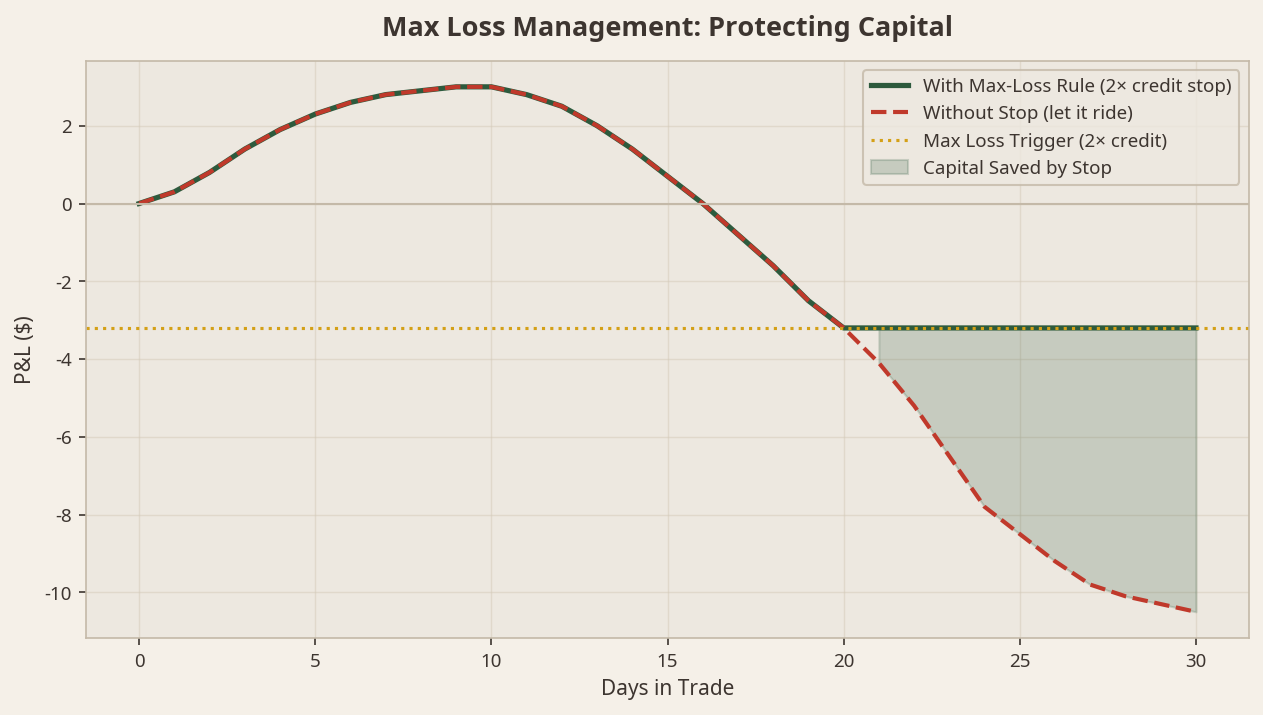
Max Loss Management: When a position reaches the 2x credit received threshold, the disciplined exit preserves capital for future trades.
The Uncomfortable Truth: Why Max Loss Management Matters Now More Than Ever
The current market environment, characterized by elevated volatility and rapid shifts in sentiment, underscores the urgency of robust risk management. While the VIX has retreated from its pandemic highs, we've seen periods of significant spikes, such as the VIX reaching above 20 in late 2023 and early 2024, indicating underlying market uncertainty. This isn't a market where you can afford to "hope" trades turn around.
High implied volatility (IV) can inflate option premiums, making credit spreads more attractive initially, but it also means that adverse moves can be swift and brutal.
Consider the impact of a sudden market downturn on a typical credit spread strategy. If you sold an out-of-the-money (OTM) put spread on SPY when the VIX was at 15, and then the VIX spiked to 25 due to an unexpected geopolitical event, your short put strike could quickly be challenged. The combination of price movement and increasing implied volatility can rapidly erode your profit and push your position deep into unprofitable territory.
Without a predefined exit strategy, many traders fall prey to emotional decision-making, holding onto losing trades in the hope of a reversal, only to see their losses multiply.
Furthermore, the rise of zero-day-to-expiration (0DTE) options has introduced an unprecedented level of gamma risk. While 0DTEs offer tantalizing premiums, they also expose traders to exponential losses if the underlying moves against them late in the day. This environment demands an even stricter adherence to options stop loss principles.
Whether you're trading short-dated options or longer-term spreads, understanding your maximum acceptable loss before entering a trade is paramount. The Volatility Anomaly system, with its focus on identifying high IV percentile opportunities and providing structured trade ideas, implicitly relies on traders having a solid risk management framework in place. Ignoring this fundamental pillar is akin to building a house without a foundation – it might stand for a while, but it's destined to collapse under pressure.
Defining Your Max Loss: The 2x Credit Received Rule and Beyond
One of the most effective and widely adopted rules for managing credit spread losses, including the iron condor max loss, is the "2x Credit Received" rule. This objective, quantifiable benchmark provides a clear signal for when to exit a losing position, removing emotion from the decision-making process.
The 2x Credit Received Rule Explained
- What it is: For any credit spread (e.g., vertical spread, iron condor, iron butterfly), if the unrealized loss on the position reaches twice the initial credit received, you close the trade.
-
Why it works:
- Preserves Capital: It prevents small losses from spiraling into catastrophic ones. If you consistently lose 2x your credit, you only need to win slightly more than 50% of your trades to be profitable, assuming your winners capture most of the credit.
- Maintains Favorable Risk/Reward: Most credit spreads are designed with a favorable probability of profit, but a skewed risk/reward (e.g., risking $200 to make $100). By cutting at 2x the credit, you cap your loss at $200, maintaining the original risk profile relative to your potential gain. If you let it go to max loss (e.g., $400), your risk/reward becomes extremely unfavorable.
- Reduces Emotional Bias: Having a predefined exit point eliminates the agonizing "should I hold or should I fold?" dilemma, which often leads to poor decisions.
- Frees Up Capital: Closing a losing trade frees up margin and capital that can be deployed into new, higher-probability opportunities.
- Example: You sell an OTM credit spread for a $1.00 credit (or $100 per contract). Your max loss rule dictates that if the unrealized loss reaches $2.00 (or $200 per contract), you close the trade.
Beyond 2x Credit: Other Max Loss Triggers
While the 2x credit rule is excellent for credit spreads, other strategies and market conditions might warrant additional or alternative options stop loss triggers:
- Delta-Based Exits: For strategies where delta is a primary concern (e.g., short deltas on a call spread), you might set a delta threshold. For example, if your short strike's delta moves from 0.15 to 0.40, indicating a significant increase in probability of being in-the-money (ITM), you might exit. This is particularly relevant for strategies like the iron condor where managing the deltas of the short strikes is crucial.
- Underlying Price Breach: For directional trades or spreads with a clear directional bias, you might set a stop loss based on the underlying asset's price. For instance, if you sold a put spread on AAPL at the $170/$165 strikes, and AAPL drops below $168, you might exit, regardless of the P&L.
- Time-Based Exits: Sometimes, a trade simply isn't working, and time decay isn't helping as expected. If a trade has been open for 75% of its duration (e.g., 30 days into a 45-day trade) and is still significantly unprofitable, it might be time to cut it loose, even if the 2x credit rule hasn't been triggered. This is especially true if IV has collapsed, reducing the potential for premium decay to bail you out.
- Max Portfolio Loss: This is an overarching risk management principle. Define a maximum percentage of your total trading capital you are willing to lose in a single day, week, or month. If your total P&L hits this threshold, you stop trading for that period. For instance, a 2% daily or 5% weekly max portfolio drawdown.
"The first rule of options trading is to protect your capital. The second rule is to never forget the first rule."
The key is to define these rules before you enter the trade. Write them down. Make them part of your trading plan.
When the market moves against you, your rules become your unwavering guide, preventing emotional decisions that lead to larger losses.
This systematic approach is a core tenet of the Volatility Anomaly methodology, where we advocate for disciplined execution over reactive trading.
Practical Application: A Worked Example with SPY Iron Condor
Let's walk through a concrete example of managing an iron condor using the 2x credit rule, incorporating elements of the Volatility Anomaly approach.
Scenario: Selling an SPY Iron Condor in a High IV Environment
Imagine it's late January 2024. The market has seen some choppiness, and the VIX is elevated around 18.00. SPY is trading at approximately $485.00.
Our Volatility Anomaly screener identifies SPY as having an IV Rank of 70%, making it a good candidate for selling premium. We decide to sell an iron condor with 45 days to expiration (DTE) targeting a 0.10-0.15 delta on the short strikes.
Entry Details:
- Underlying: SPY @ $485.00
- DTE: 45 days
- VIX: 18.00
- IV Rank: 70%
- Strategy: Iron Condor (1 contract)
- Short Call Strike (Delta ~0.15): $495.00
- Long Call Strike: $500.00 (Call Spread Width: $5.00)
- Credit Received for Call Spread: $0.75
- Short Put Strike (Delta ~0.15): $475.00
- Long Put Strike: $470.00 (Put Spread Width: $5.00)
- Credit Received for Put Spread: $0.75
- Total Credit Received for Iron Condor: $0.75 + $0.75 = $1.50 (or $150 per contract)
- Max Profit: $150
- Max Loss (at expiration): Spread Width - Credit Received = $5.00 - $1.50 = $3.50 (or $350 per contract)
Our goal is to profit from SPY staying between $475 and $495.
Max Loss Rule Defined:
Following the 2x Credit Received rule:
- Max Loss Trigger: 2 * $1.50 = $3.00 (or $300 per contract).
- If the market value of the iron condor reaches a debit of $3.00 (meaning you'd pay $3.00 to close it), we exit the trade.
Trade Management & Exit:
Fast forward two weeks. SPY has experienced a sharp downturn due to unexpected economic data, falling from $485.00 to $472.00. The VIX has also spiked to 22.00.
- Current SPY Price: $472.00
- DTE Remaining: 31 days
- VIX: 22.00
Our short put strike at $475.00 is now in-the-money (ITM). The value of the put spread has increased dramatically.
- Current Value of Call Spread: The $495/$500 call spread is now far OTM and might be worth only $0.05.
- Current Value of Put Spread: The $475/$470 put spread, which we sold for $0.75, is now trading at approximately $2.90. (The $475 put is ITM, and the $470 put is near the money, with increased IV boosting its premium).
- Current Market Value of Iron Condor: We would have to pay $2.90 (for the put spread) - $0.05 (for the call spread) = $2.85 to close the entire iron condor.
- Unrealized Loss: Current Market Value - Initial Credit = $2.85 - $1.50 = $1.35. This is the net debit to close the trade. However, when comparing to the 2x credit rule, we look at the cost to close. The initial credit was $1.50. The current cost to close is $2.85. The "loss" in terms of the rule is the current cost to close.
- Wait, let's reframe for clarity: Initial credit received was $1.50. If we bought it back for $2.85, our loss is $1.35. The 2x credit rule is often interpreted as "if the cost to close reaches 2x the credit received". In our case, 2 * $1.50 = $3.00. The current cost to close is $2.85. We are close to the trigger.
Let's assume the market continues to drop slightly, and the next day, SPY is at $471.00.
- Current Market Value of Put Spread: Now trading at approximately $3.10.
- Current Market Value of Iron Condor: $3.10 (put spread) - $0.05 (call spread) = $3.05.
- Decision: The cost to close the iron condor ($3.05) has now exceeded our 2x credit received trigger of $3.00.
Action: We immediately place an order to buy back the entire iron condor for $3.05.
- Initial Credit: $1.50
- Cost to Close: $3.05
- Net Loss: $1.55 (or $155 per contract)
By adhering to our iron condor max loss rule, we limited our loss to $155, which is just over 1x the credit received. Had we waited for max loss at expiration, if SPY continued to fall below $470, our loss could have been the full $350.
This early exit preserved $195 of capital that would have otherwise been lost. This capital can now be redeployed into a new trade identified by the Volatility Anomaly automated screener, perhaps a new high IV percentile opportunity on a different ticker.
Risk Management: What Can Go Wrong and How to Protect Yourself
Even with the best max loss rules, options trading carries inherent risks. Understanding these and proactively mitigating them is crucial for long-term success.
Common Pitfalls and How to Avoid Them:
-
Emotional Attachment to Trades: This is the biggest enemy of max loss management. Traders often "hope" a losing trade will turn around, ignoring their predefined rules.
- Protection: Automate your stop-loss orders if your broker allows it. If not, set alerts (price alerts, P&L alerts) that trigger when your max loss threshold is approached. Treat your max loss rule as non-negotiable.
-
"Averaging Down" on Losing Spreads: Adding more contracts to a losing spread in an attempt to lower your average entry price is often a recipe for disaster. It increases your overall risk exposure to an already problematic trade.
- Protection: Stick to your original trade plan and position sizing. If a trade hits its max loss, close it. Do not double down.
-
Ignoring Skew and Volatility Spikes: Sudden increases in implied volatility (VIX spikes) can dramatically increase the cost of closing a short option spread, even if the underlying hasn't moved as much as expected. Skew (the difference in IV between OTM puts and calls) can also make put spreads more expensive to manage during downturns.
- Protection: Be mindful of VIX levels and IV Rank when entering trades. Consider smaller position sizes during periods of elevated uncertainty. The Volatility Anomaly platform highlights these metrics precisely for this reason.
-
Lack of Liquidity: For less liquid options, especially on smaller-cap stocks or far OTM strikes, closing a spread at your desired price can be difficult. Wide bid-ask spreads can eat into your capital.
- Protection: Stick to highly liquid underlying assets like SPY, QQQ, AAPL, MSFT, GOOGL. Always check the bid-ask spread before entering and exiting. Use limit orders for closing trades, even if it means waiting a bit longer.
-
Over-Leveraging: Trading too many contracts relative to your account size means a single losing trade can wipe out a significant portion of your capital, making it impossible to recover.
- Protection: Implement strict position sizing rules. A common guideline is to risk no more than 1-2% of your total trading capital on any single trade. If your account is $25,000, and your max loss on an iron condor is $150, you can trade up to 3 contracts ($450 loss / $25,000 = 1.8%).
-
Not Monitoring Positions: "Set it and forget it" is a dangerous mindset in options trading. Markets move, and your positions need attention.
- Protection: Regularly monitor your open positions. The Volatility Anomaly platform offers tools for position monitoring and alerts. Check your P&L and the underlying's price at least once a day, or more frequently for short-dated options.
Remember, the goal of options risk management is not to eliminate losses entirely, but to control their size and frequency. By diligently applying these protective measures, you transform potential disasters into minor inconveniences, allowing your winning trades to compound over time.
Advanced Considerations for Experienced Traders
For seasoned options traders, max loss management isn't just about a static rule; it involves dynamic adjustments and a deeper understanding of market mechanics.
Dynamic Adjustments vs. Hard Stops
While the 2x credit rule is an excellent starting point, experienced traders might consider dynamic adjustments before hitting the hard stop.
- Rolling the Unchallenged Side: If one side of an iron condor is challenged (e.g., puts are ITM), and the other side (calls) is far OTM and has decayed significantly, you might consider buying back the profitable, unchallenged side for a small debit. This reduces your capital at risk and frees up margin. Then, you manage the remaining challenged spread as a standalone vertical. This is a partial adjustment, not a full exit.
- Rolling the Challenged Side Out and/or Down/Up: If your short put strike at $475 on SPY is challenged, you might roll the entire $475/$470 put spread to a lower strike (e.g., $470/$465) and/or to a further expiration date for a credit. This buys you more time and space. However, this is effectively "averaging down" on a losing position and should be done with extreme caution, only if you believe the underlying will reverse or consolidate, and only if you receive a net credit for the roll. This increases your max potential loss and ties up capital longer. It's a strategic decision, not a reactive one.
- Gamma Scalping / Delta Hedging: For very active traders, especially those dealing with larger positions or short-dated options, delta hedging can be a form of dynamic max loss management. If your short put spread on SPY is challenged and your position delta becomes significantly negative (e.g., -50 delta), you might buy shares of SPY or short calls to bring your delta closer to neutral, reducing directional risk. This is complex and requires constant monitoring.
The Role of VIX and IV Percentile in Exit Decisions
Beyond just the P&L, the implied volatility environment should influence your exit strategy.
- Collapsing IV: If you sold premium when IV was high (e.g., SPY IV Rank 70%) and it has since collapsed (e.g., IV Rank 20%), your profitable trades might be worth closing early to lock in gains, even if they haven't reached your full profit target (e.g., 50% of max profit). Conversely, if a losing trade is still far OTM but IV has collapsed, the likelihood of it becoming profitable due to time decay might be diminished, making an early exit more prudent.
- Spiking IV: If you are in a losing credit spread and IV spikes significantly (e.g., VIX jumps from 15 to 25), the cost to close your losing spread will be exacerbated. This might push you to your 2x credit max loss faster than expected. It also means that new opportunities to sell premium might be emerging, providing a strong incentive to close the old losing trade and redeploy capital. The Volatility Anomaly system excels at identifying these high IV percentile opportunities.
Tax Implications of Early Exits
While not directly a risk management technique, understanding the tax implications of frequent short-term losses is important. In the US, capital losses can offset capital gains, and up to $3,000 of ordinary income per year. However, wash sale rules can apply if you repurchase a substantially identical security within 30 days.
Consult a tax professional for personalized advice.
The key is that realizing losses is part of the game, and sometimes, those losses can be strategically beneficial from a tax perspective, provided you adhere to the rules.
Ultimately, advanced max loss management is about integrating these factors into a holistic trading plan. It's about having the flexibility to adapt to market conditions while maintaining the discipline to protect capital.
Conclusion & Key Takeaways
Mastering maximum loss management is not merely a suggestion; it is a fundamental requirement for survival and success in options trading. The market is an unforgiving arena, and those who fail to protect their capital inevitably find themselves on the sidelines.
By proactively defining your options stop loss rules, such as the 2x credit received for credit spreads and iron condor max loss, you transform emotional, reactive decisions into disciplined, objective actions. This discipline, combined with a keen understanding of market dynamics and a robust risk management framework, is what separates consistent performers from those who merely gamble.
At Volatility Anomaly, we empower traders with the tools and knowledge to identify high-probability trades. But even the highest probability trade can go awry. It is your commitment to capital preservation that will ensure you are always ready for the next great opportunity.
Embrace the loss, learn from it, and move on. Your trading account will thank you.
Key Takeaways for Effective Max Loss Management:
- Define Your Max Loss BEFORE the Trade: Establish clear, objective rules like the "2x Credit Received" for credit spreads. Do this for every trade, and write it down in your trading plan.
- Prioritize Capital Preservation: Your primary goal is to protect your trading capital. Small, controlled losses are part of the game; catastrophic losses are not.
- Remove Emotion with Automation/Alerts: Use automated stop-loss orders or P&L alerts to trigger your exit. Do not "hope" a losing trade will turn around.
- Understand Your Strategy's Risk Profile: Know the max potential loss of your strategy at expiration and how early exits impact your overall risk/reward. For an iron condor max loss, cutting at 2x credit significantly reduces your exposure compared to holding to expiration.
- Implement Strict Position Sizing: Never risk more than 1-2% of your total trading capital on a single trade. Over-leveraging amplifies losses exponentially.
- Monitor Market Conditions: Pay attention to VIX levels, IV Rank, and underlying price action. These can accelerate losses or create new opportunities. The Volatility Anomaly platform helps you stay informed.
- Be Prepared to Cut and Redeploy: Acknowledge that a loss is a cost of doing business. Close the losing trade, free up capital, and seek out the next high-probability setup.
#VolatilityAnomaly · #IVRank · #OptionsTrading · #VRP
You Might Also Like

Volatility Anomaly
Portfolio-Level Hedging for Iron Condor Traders: Using VIX Calls as Insurance
Portfolio-Level Hedging for Iron Condor Traders: Using VIX Calls as Insurance Portfolio-Level Hedging for Iron Condor Traders: Using VIX Calls as Insurance In the world of options trading, strategies like the Iron Condor are highly popular for their ability to generate consistent
Jan 1970

Volatility Anomaly
Gamma Risk in Iron Condors: Understanding the Danger Zone Near Expiration
Gamma Risk in Iron Condors: Understanding the Danger Zone Near Expiration As options traders, we often seek strategies that offer defined risk and a high probability of profit. The iron condor, a staple in many portfolios, perfectly embodies this philosophy. By selling out-of-the
Jan 1970
YOU MIGHT ALSO LIKE
Portfolio-Level Hedging for Iron Condor Traders: Using VIX Calls as Insurance
Portfolio-Level Hedging for Iron Condor Traders: Using VIX Calls as Insurance Portfolio-Level Hedging for Iron…
Read articleGamma Risk in Iron Condors: Understanding the Danger Zone Near Expiration
Gamma Risk in Iron Condors: Understanding the Danger Zone Near Expiration As options traders, we often seek st…
Read articleThe 50% Profit Target Rule: Why Closing Early Improves Your Long-Term Returns
The 50% Profit Target Rule: Why Closing Early Improves Your Long-Term Returns In the dynamic world of options…
Read articleThis article is for educational purposes only and does not constitute financial or investment advice. Options trading involves significant risk of loss and is not suitable for all investors. Past performance is not indicative of future results.