The Volatility Risk Premium: A Professional Guide to Selling Options with a Structural Edge
The volatility risk premium — the persistent gap between implied and realized volatility — is the structural foundation of every premium-selling strategy. This Professional guide explains why it exists, how to measure it with IV Rank, and how to exploit it systematically with iron condors and defined-risk structures.
Abstract
The volatility risk premium — the persistent gap between implied and realized volatility — is the structural foundation of every premium-selling strategy. This Professional guide explains why it exists, how to measure it with IV Rank, and how to exploit it systematically with iron condors and defined-risk structures.
The Volatility Premium: Why Selling Options Has a Structural Edge
Every options trader eventually encounters the same empirical puzzle: implied volatility consistently overstates realized volatility. This gap — known as the volatility risk premium — is not a market inefficiency waiting to be arbitraged away.
It is a structural feature of how markets price uncertainty. It represents one of the most durable edges available to systematic premium sellers.
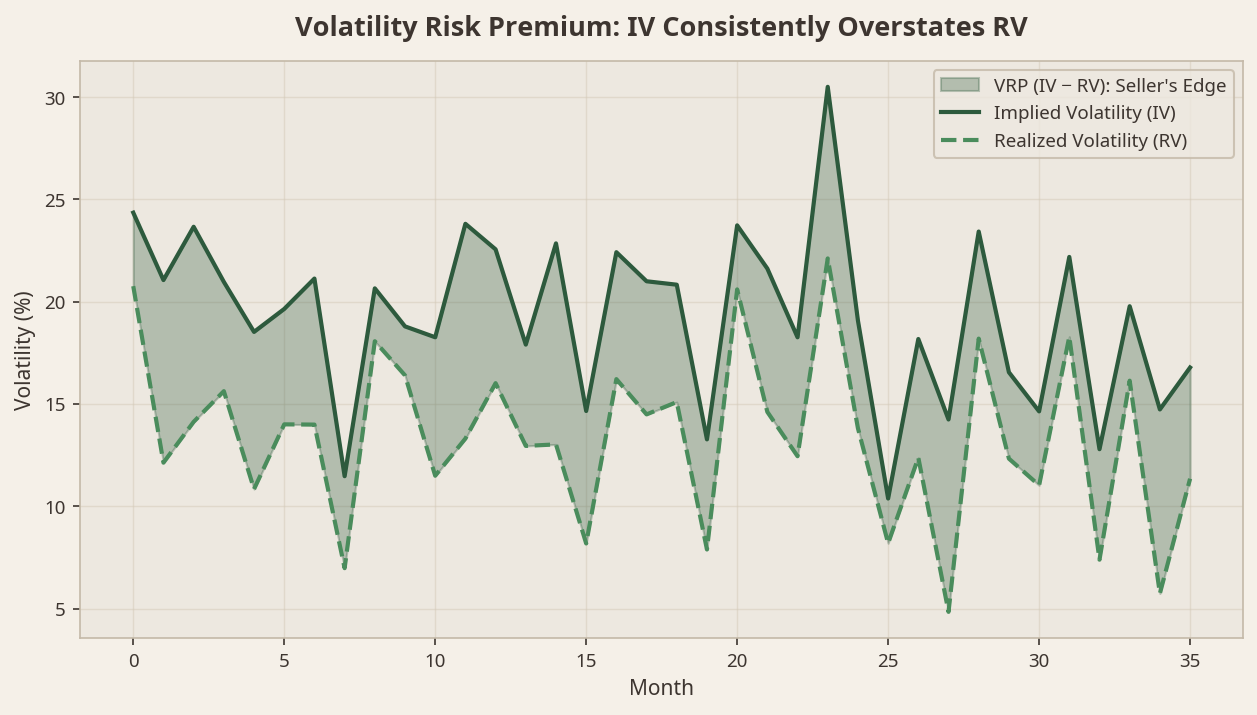
The Volatility Risk Premium: Implied volatility (green) consistently overstates realized volatility (white), creating a persistent structural edge for premium sellers.
Key Takeaway: The volatility risk premium has persisted for over 30 years across equities, indices, and commodities. Implied volatility overstates realized volatility roughly 80% of the time in equity index options, creating a systematic edge for disciplined premium sellers.
What Is the Volatility Risk Premium?
When you buy an option, you are paying the market's estimate of how much the underlying will move before expiration — the implied volatility. When the option expires, you can compare that estimate to what actually happened — the realized volatility.
The difference between these two quantities, averaged over many expirations, is the volatility risk premium (VRP).
Historically, for S&P 500 index options, implied volatility has exceeded realized volatility by an average of 3–5 volatility points. This means that if the market implies a 20% annualized move, the actual move tends to be closer to 15–17%.
The seller of that option collects premium priced for a 20% world but only needs to survive a 15–17% world.
| Asset | Avg. IV | Avg. RV | VRP (IV - RV) | Win Rate |
|---|---|---|---|---|
| SPX (30-day) | 18.2% | 14.1% | +4.1 pts | 82% |
| QQQ (30-day) | 22.4% | 17.8% | +4.6 pts | 79% |
| Individual stocks | 35.1% | 28.3% | +6.8 pts | 74% |
| Gold (GLD) | 16.3% | 12.9% | +3.4 pts | 77% |
Why the VRP Persists
The volatility risk premium exists because options buyers are willing to pay a premium for insurance. Portfolio managers buying puts to hedge equity exposure, retail traders buying calls to speculate with defined risk, and institutions buying straddles to hedge earnings exposure — all of these participants are paying above fair value for the protection or leverage that options provide.
This is not irrational behavior. The insurance buyer is not wrong to pay above actuarial value for fire insurance on their house. They are paying for peace of mind and the elimination of catastrophic downside.
Options buyers are doing the same thing. The premium seller is simply the insurance company — collecting small, consistent premiums in exchange for accepting tail risk.
Key Takeaway: The VRP is not a free lunch. It is compensation for bearing tail risk. The edge comes from systematic risk management — position sizing, diversification, and defined-risk structures — not from the VRP alone.
IV Rank: The Premium Seller's Most Important Metric
Not all implied volatility environments are equal. Selling options when IV is at historically low levels is a fundamentally different proposition than selling when IV is elevated.
IV Rank (IVR) standardizes the current implied volatility reading against its 52-week range, giving you a percentile score from 0 to 100.
An IV Rank of 80 means the current IV is in the 80th percentile of its 52-week range — historically elevated, and therefore a favorable environment for premium selling. An IV Rank of 20 means IV is near its annual lows — premium is cheap, and selling it offers poor risk/reward.
The Volatility Anomaly Screener filters for stocks with IV Rank above 50 as a baseline requirement for all iron condor setups. For the most aggressive premium-selling environments, we look for IV Rank above 70 combined with IV Percentile above 60.
Applying the VRP with Iron Condors
The iron condor is the canonical premium-selling structure for stocks expected to remain range-bound. By selling an out-of-the-money call spread and an out-of-the-money put spread simultaneously, you collect premium from both sides of the distribution while capping your maximum loss.
The structural edge of the iron condor in a high-IV environment comes directly from the VRP: you are selling options priced for a large move, but the historical base rate suggests the actual move will be smaller.
Your short strikes are set at the 1-standard-deviation level implied by the options market — but the realized move will, on average, fall short of that level roughly 68–82% of the time (depending on the asset and IV regime).
Risk Management: The Non-Negotiable Half
The VRP gives you a statistical edge over many trades. It does not protect you from any individual trade. Tail events — earnings surprises, macro shocks, sector-specific news — can and will move stocks beyond your short strikes.
The discipline of premium selling is not in finding the edge (the VRP provides that) but in managing the inevitable losers so they do not overwhelm the consistent winners.
The Volatility Anomaly System applies three non-negotiable risk rules to every iron condor position:
- 50% profit target: Close the position when it reaches 50% of maximum profit. This captures the majority of the theta decay while eliminating gamma risk in the final days before expiration.
- 200% loss stop: Close the position if it reaches a loss equal to twice the premium collected. This prevents any single trade from being catastrophic.
- Position sizing: No single iron condor position exceeds 5% of total portfolio buying power. Diversification across 10–20 uncorrelated positions is the primary risk management tool.
Conclusion: The Edge Is Real, But Discipline Is Required
The volatility risk premium is one of the most well-documented and persistent anomalies in financial markets. It has survived the rise of algorithmic trading, the proliferation of retail options traders, and multiple market crises.
It persists because it is not an inefficiency — it is compensation for bearing tail risk that most market participants are unwilling or unable to accept.
For systematic premium sellers who apply disciplined position sizing, defined-risk structures, and consistent profit-taking rules, the VRP represents a genuine, repeatable edge. The Volatility Anomaly System is built entirely around capturing this premium efficiently while managing the tail risk that comes with it.
#VolatilityAnomaly · #IVRank · #OptionsTrading · #VRP
You Might Also Like

Volatility Anomaly
Portfolio-Level Hedging for Iron Condor Traders: Using VIX Calls as Insurance
Portfolio-Level Hedging for Iron Condor Traders: Using VIX Calls as Insurance Portfolio-Level Hedging for Iron Condor Traders: Using VIX Calls as Insurance In the world of options trading, strategies like the Iron Condor are highly popular for their ability to generate consistent
Jan 1970

Volatility Anomaly
Gamma Risk in Iron Condors: Understanding the Danger Zone Near Expiration
Gamma Risk in Iron Condors: Understanding the Danger Zone Near Expiration As options traders, we often seek strategies that offer defined risk and a high probability of profit. The iron condor, a staple in many portfolios, perfectly embodies this philosophy. By selling out-of-the
Jan 1970
YOU MIGHT ALSO LIKE
Portfolio-Level Hedging for Iron Condor Traders: Using VIX Calls as Insurance
Portfolio-Level Hedging for Iron Condor Traders: Using VIX Calls as Insurance Portfolio-Level Hedging for Iron…
Read articleGamma Risk in Iron Condors: Understanding the Danger Zone Near Expiration
Gamma Risk in Iron Condors: Understanding the Danger Zone Near Expiration As options traders, we often seek st…
Read articleThe 50% Profit Target Rule: Why Closing Early Improves Your Long-Term Returns
The 50% Profit Target Rule: Why Closing Early Improves Your Long-Term Returns In the dynamic world of options…
Read articleThis article is for educational purposes only and does not constitute financial or investment advice. Options trading involves significant risk of loss and is not suitable for all investors. Past performance is not indicative of future results.