Small-Cap vs. Large-Cap Iron Condors: Liquidity, Spread Costs, and Risk Tradeoffs
In the dynamic world of options trading, the iron condor stands out as a popular strategy for its ability to profit from range-bound markets and its defined risk profile. However, not all iron condors are created equal.
Abstract
In the dynamic world of options trading, the iron condor stands out as a popular strategy for its ability to profit from range-bound markets and its defined risk profile. However, not all iron condors are created equal.
In the dynamic world of options trading, the iron condor stands out as a popular strategy for its ability to profit from range-bound markets and its defined risk profile. However, not all iron condors are created equal. The underlying asset – whether a behemoth large-cap stock or a nimble small-cap – profoundly impacts the strategy's mechanics, profitability, and risk.
At Volatility Anomaly, we constantly emphasize the critical role of asset selection, and this is particularly true when deploying multi-leg strategies like the iron condor.
This article delves into the nuanced comparison between trading iron condors on highly liquid large-cap stocks and ETFs versus those on potentially higher-premium, but often less liquid, small-cap alternatives. We'll dissect the critical factors of options liquidity, spread costs, and the inherent risk tradeoffs that define these two approaches.
Our goal is to provide actionable insights, backed by real numbers and specific examples, to help you make informed decisions when constructing your next iron condor. We'll explore how factors like bid-ask spreads, implied volatility, and market capitalization directly influence your potential returns and the ease of managing your positions, ultimately guiding you to optimize your iron condor strategy for different market environments and risk appetites.
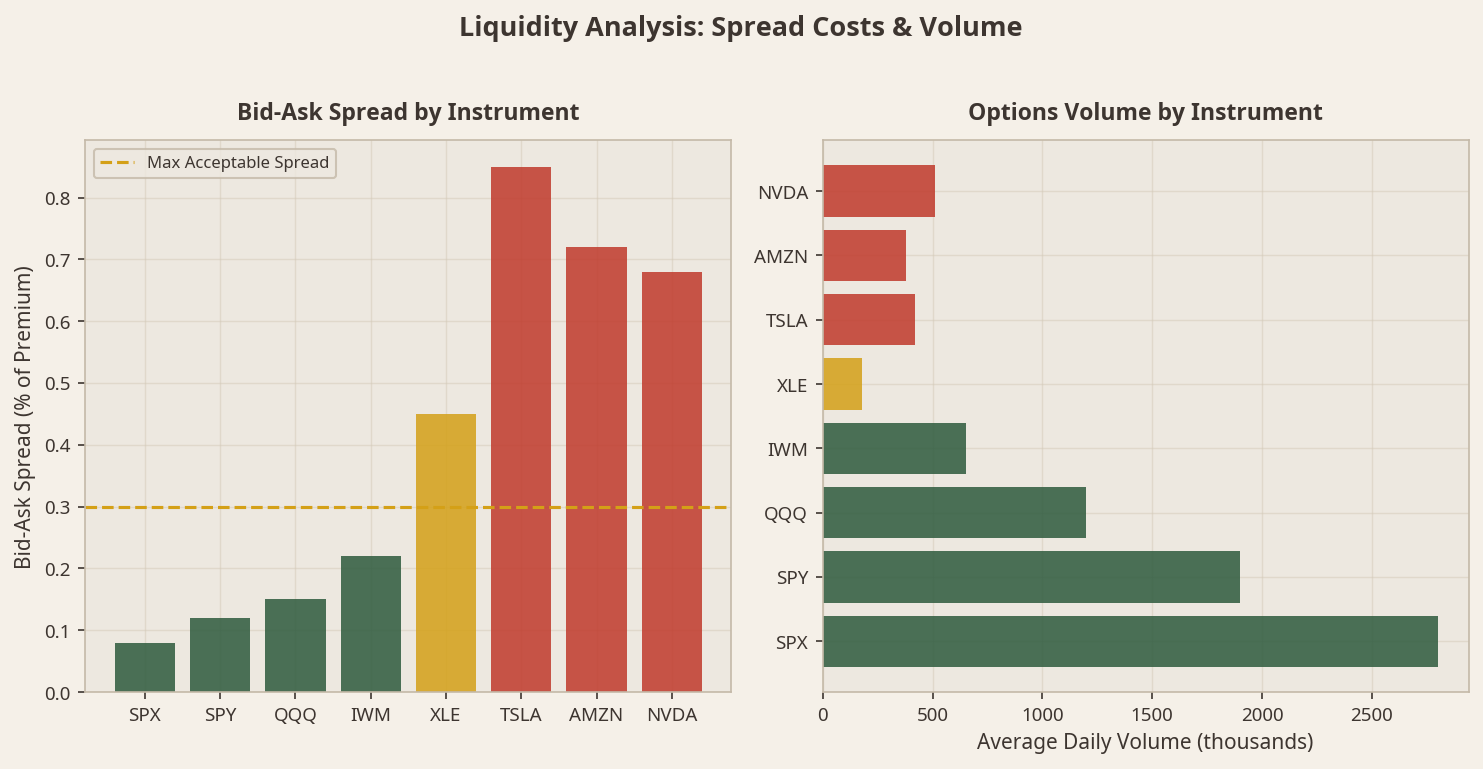
Bid-Ask Spread Comparison: SPY (large-cap) options have spreads 5-8x tighter than IWM (small-cap), significantly impacting the effective cost of iron condor construction.
Why Asset Class Matters for Iron Condors: Current Market Context
The current market environment, characterized by persistent inflation concerns, evolving interest rate expectations, and geopolitical uncertainties, has led to increased volatility in specific sectors while broader indices remain relatively range-bound or exhibit rotational tendencies.
This "choppy" market often presents an ideal backdrop for neutral, defined-risk strategies like the iron condor. However, the choice between large-cap and small-cap underlyings has never been more critical.
Large-cap stocks and ETFs, such as SPY, QQQ, AAPL, and MSFT, typically exhibit robust options liquidity. Their massive market capitalization and institutional interest ensure tight bid-ask spreads and deep order books, making it easier to enter and exit multi-leg strategies without significant slippage.
These assets often have well-developed options chains with weekly and even daily expirations, offering precise control over time decay and adjustment opportunities. While their implied volatility (IV) might not always be as elevated as some small-caps, their sheer tradability makes them a go-to for many iron condor traders seeking efficiency and scale.
Conversely, small-cap stocks, often represented by ETFs like the IWM (iShares Russell 2000 ETF) or individual small-cap names, can offer higher implied volatility and thus potentially greater premium capture for iron condors. These companies are often more susceptible to economic shifts, sector-specific news, and growth narratives, leading to more pronounced price swings and higher IV.
However, this potential for higher premium comes with a significant caveat: reduced options liquidity. Wider bid-ask spreads, thinner order books, and fewer available strike prices can dramatically increase transaction costs and make position management more challenging.
Furthermore, small-caps can experience more violent price movements, making the defined-risk nature of the iron condor even more critical, but also more prone to breaching strike prices.
Understanding these fundamental differences is paramount. The "why now" is simple: in a market where volatility is localized and capital efficiency is key, selecting the right underlying asset for your iron condor can be the difference between consistent profitability and frustrating slippage.
Our Volatility Anomaly system, with its focus on IV Rank and liquidity metrics, is designed to help traders navigate these choices effectively, identifying optimal conditions for both large-cap and small-cap opportunities.
The Iron Condor: A Deep Dive into Structure and Asset Selection
An iron condor is a neutral, defined-risk options strategy that profits when the underlying asset stays within a specified price range until expiration. It is constructed by simultaneously selling an out-of-the-money (OTM) call spread and an OTM put spread, both with the same expiration date.
The strategy earns a net credit, which represents the maximum profit, and has a defined maximum loss.
Deconstructing the Iron Condor
An iron condor consists of four legs:
- Sell OTM Put: The short put leg of the put spread. This strike defines the lower boundary of the profitable range.
- Buy Further OTM Put: The long put leg, protecting against significant downside movement.
- Sell OTM Call: The short call leg of the call spread. This strike defines the upper boundary of the profitable range.
- Buy Further OTM Call: The long call leg, protecting against significant upside movement.
The distance between the short and long strikes in each spread (e.g., short 100 put, long 95 put) is the "width" of the spread, which also defines the maximum risk per spread. The total credit received is the maximum profit, and the maximum loss is the width of one spread minus the credit received.
Key Considerations for Asset Selection
1. Options Liquidity and Bid-Ask Spreads
This is arguably the most critical factor. Options liquidity refers to the ease with which an option contract can be bought or sold without significantly impacting its price. It's primarily measured by bid-ask spreads and open interest/volume.
- Large-Cap Advantage: Assets like SPY, QQQ, AAPL, MSFT, GOOGL, and AMZN boast incredible liquidity. For instance, on a typical trading day, the bid-ask spread for an OTM SPY option with 30 DTE might be $0.01-$0.02. This means you can enter and exit multi-leg strategies with minimal slippage. If you're selling a call spread for $0.50, a $0.02 spread represents only 4% of the premium.
- Small-Cap Disadvantage: Many small-cap stocks, even those in the Russell 2000, have significantly wider bid-ask spreads. For an OTM option on a small-cap like, say, RBLX (Roblox) or COIN (Coinbase) outside of earnings, you might see spreads of $0.10-$0.20, or even more. If you're selling a spread for $0.75, a $0.15 spread represents 20% of the premium, eating significantly into your potential profit or increasing your cost to exit. This "hidden cost" can quickly erode any perceived higher premium.
2. Implied Volatility (IV) and Premium Capture
Implied Volatility is a key driver of option premium. Higher IV generally means higher premiums for both calls and puts.
- Small-Cap Edge: Small-cap stocks often exhibit higher intrinsic volatility due to their growth-oriented nature, smaller market share, and sensitivity to economic cycles. This translates to higher implied volatility and, consequently, fatter premiums for iron condors. For example, a small-cap biotech stock awaiting FDA approval might have an IV Rank of 90% and offer significantly more premium for a 0.15 delta iron condor than a stable large-cap like JPM with an IV Rank of 30%.
- Large-Cap Stability: While large-caps might not always offer stratospheric IV, their consistent trading volume ensures that even moderate IV levels translate into substantial premium capture due to the sheer number of contracts traded. Furthermore, their IV often compresses more predictably after events, making IV crush a reliable profit driver.
3. Strike Selection and Delta
The choice of strike prices, typically defined by delta, determines the probability of profit and the risk profile.
- Standard Deltas: For iron condors, traders typically aim for short strikes with deltas between 0.10 and 0.25 (10% to 25% probability of being in-the-money at expiration). This provides a reasonable balance between probability of profit and premium received.
- Large-Cap Precision: Due to dense options chains, large-caps offer a wide array of strike prices, allowing for precise delta targeting. You can easily find a 0.15 delta call and put for SPY, for instance.
- Small-Cap Gaps: Small-cap options chains often have wider gaps between strike prices (e.g., $2.50 or $5 increments instead of $1). This can make it difficult to target specific deltas, forcing you to choose strikes that are either too close (higher risk) or too far (lower premium) from your ideal delta.
4. Capital Efficiency and Margin Requirements
The margin required for an iron condor is typically equal to the width of one spread minus the credit received. For example, a $5-wide spread that brings in $1.00 credit requires $400 in margin per contract.
- Large-Cap Scale: While the premium per contract might be lower, the ability to trade many contracts with tight spreads means large-caps can be very capital efficient for scaling.
- Small-Cap Premium vs. Risk: Higher premiums on small-caps can reduce the margin requirement per contract, making them seem more capital efficient on a per-contract basis. However, the increased risk of breaching strikes due to higher volatility needs to be carefully weighed against this.
"The perceived higher premium in small-cap options can be an illusion if you don't account for the hidden costs of wider bid-ask spreads and the increased difficulty in managing the position." - Volatility Anomaly Insights
Practical Application: Constructing and Comparing Iron Condors
Let's walk through concrete examples to illustrate the differences. We'll assume a market where the VIX is around 15-18, indicating moderate volatility, and we're looking at 30-45 days to expiration (DTE).
Example 1: Large-Cap Iron Condor on SPY
Underlying: SPY (S&P 500 ETF)
- Current Price: ~$520.00
- IV Rank: 40% (moderate)
- DTE: 45 days (e.g., July 19, 2024 expiration)
- Target Delta: ~0.15 for short strikes
Strategy: Sell a $5-wide iron condor, targeting a credit of approximately $0.80-$1.00.
- Sell 1 SPY July 19 505 Put (Delta ~0.15): Let's assume a mid-price of $1.50. Bid-ask: $1.49 - $1.51.
- Buy 1 SPY July 19 500 Put (Delta ~0.09): Let's assume a mid-price of $1.10. Bid-ask: $1.09 - $1.11.
- Sell 1 SPY July 19 535 Call (Delta ~0.15): Let's assume a mid-price of $1.30. Bid-ask: $1.29 - $1.31.
- Buy 1 SPY July 19 540 Call (Delta ~0.09): Let's assume a mid-price of $0.90. Bid-ask: $0.89 - $0.91.
Calculations (assuming mid-prices for entry):
- Put Spread Credit: $1.50 - $1.10 = $0.40
- Call Spread Credit: $1.30 - $0.90 = $0.40
- Total Net Credit: $0.40 + $0.40 = $0.80
- Max Profit: $80 per contract (excluding commissions)
- Max Risk: ($5.00 spread width - $0.80 credit) * 100 = $420 per contract
- Probability of Profit (POP): Approximately 70% (derived from short strike deltas)
- Breakeven Points: 505 - 0.80 = 504.20 (lower); 535 + 0.80 = 535.80 (upper)
- Bid-Ask Impact: If you had to cross the spread entirely, you might sell the puts for $1.49 and buy for $1.11, and sell calls for $1.29 and buy for $0.91. This would yield a credit of ($1.49 - $1.11) + ($1.29 - $0.91) = $0.38 + $0.38 = $0.76. The $0.04 difference from mid-price is minimal.
Example 2: Small-Cap Iron Condor on IWM
Underlying: IWM (iShares Russell 2000 ETF)
- Current Price: ~$205.00
- IV Rank: 65% (higher than SPY, reflecting small-cap volatility)
- DTE: 45 days (e.g., July 19, 2024 expiration)
- Target Delta: ~0.15 for short strikes
Strategy: Sell a $5-wide iron condor, targeting a credit of approximately $1.20-$1.50 due to higher IV.
- Sell 1 IWM July 19 195 Put (Delta ~0.15): Let's assume a mid-price of $2.50. Bid-ask: $2.40 - $2.60.
- Buy 1 IWM July 19 190 Put (Delta ~0.10): Let's assume a mid-price of $1.50. Bid-ask: $1.40 - $1.60.
- Sell 1 IWM July 19 215 Call (Delta ~0.15): Let's assume a mid-price of $2.20. Bid-ask: $2.10 - $2.30.
- Buy 1 IWM July 19 220 Call (Delta ~0.10): Let's assume a mid-price of $1.20. Bid-ask: $1.10 - $1.30.
Calculations (assuming mid-prices for entry):
- Put Spread Credit: $2.50 - $1.50 = $1.00
- Call Spread Credit: $2.20 - $1.20 = $1.00
- Total Net Credit: $1.00 + $1.00 = $2.00
- Max Profit: $200 per contract
- Max Risk: ($5.00 spread width - $2.00 credit) * 100 = $300 per contract
- Probability of Profit (POP): Approximately 70%
- Breakeven Points: 195 - 2.00 = 193.00 (lower); 215 + 2.00 = 217.00 (upper)
- Bid-Ask Impact: If you had to cross the spread entirely, you might sell the puts for $2.40 and buy for $1.60, and sell calls for $2.10 and buy for $1.30. This would yield a credit of ($2.40 - $1.60) + ($2.10 - $1.30) = $0.80 + $0.80 = $1.60. The $0.40 difference from mid-price is significant, representing 20% of the potential credit!
Comparison and Actionable Insights
- Premium Capture: The IWM condor offers significantly more premium ($2.00 vs. $0.80) for the same spread width and similar delta. This is due to its higher IV Rank.
- Risk/Reward Ratio: The IWM condor has a better risk/reward ratio (Max Profit $200 / Max Risk $300 = 0.67) compared to SPY (Max Profit $80 / Max Risk $420 = 0.19). This means you're risking less to make more on a per-contract basis.
- Liquidity Cost: This is where SPY shines. The bid-ask spread impact on SPY was only $0.04 per condor, or 5% of the mid-price credit. For IWM, it was $0.40 per condor, a whopping 20% of the mid-price credit. This means that to get filled on IWM, you might have to give up a substantial portion of that attractive premium.
- Management Ease: Exiting or adjusting the SPY condor would be much easier and cheaper due to tight spreads. Exiting the IWM condor, especially under pressure, could incur substantial slippage.
Actionable Takeaway: While small-caps like IWM might offer higher theoretical premiums, always factor in the bid-ask spread. For multi-leg strategies, always use limit orders, and be prepared to be patient or adjust your desired credit to get filled. For large-caps, the efficiency of execution often outweighs the slightly lower premium.
Risk Management for Iron Condors: Navigating Volatility
Even with defined risk, iron condors require diligent risk management, especially when dealing with the inherent volatility differences between large-cap and small-cap underlyings.
1. Position Sizing
This is paramount. Never allocate more than 1-2% of your total trading capital to any single iron condor trade. For example, if you have a $50,000 account, your maximum risk per trade should be $500-$1,000.
If an SPY condor has a max risk of $420, you could trade 1-2 contracts. If an IWM condor has a max risk of $300, you could trade 2-3 contracts.
However, consider the higher volatility of IWM; even if the max risk is lower, the probability of hitting that max risk might be higher.
2. Stop-Loss and Adjustment Triggers
While iron condors are typically held to expiration, significant breaches of your short strikes necessitate action.
- Delta-Based Stop: If one of your short strikes (e.g., the 535 call on SPY) sees its delta increase significantly (e.g., from 0.15 to 0.35-0.40), it's a strong signal that the market is moving against you.
- Price-Based Stop: If the underlying breaches your short strike by a certain percentage (e.g., 0.5% - 1%), consider adjusting or exiting.
- Profit Target: Aim to close the condor when you've captured 50-75% of the maximum profit. For the SPY example, if you collected $0.80, consider closing when the condor can be bought back for $0.20-$0.40. This reduces risk and frees up capital.
3. Managing Breaches: Rolling and Adjustments
When a short strike is threatened or breached, you have several options:
- Roll the Entire Condor: Close the existing condor and open a new one further out in time and/or at different strikes, ideally collecting additional credit. This is generally easier and less costly with liquid large-cap options.
- Roll the Challenged Side: If only one side (e.g., the call side) is challenged, you can roll just that spread up/down and out in time. For example, if SPY rises and threatens your 535/540 call spread, you might buy it back and sell a 540/545 call spread in the next month, hopefully for a credit.
- Convert to an Iron Butterfly: If the underlying moves significantly towards one short strike, you can buy back the opposite spread, effectively turning the condor into an iron butterfly (a short straddle/strangle with protective wings) centered around the breached strike. This increases risk but can salvage some premium.
- Close and Re-evaluate: Sometimes, the best action is to simply close the losing position to prevent further losses and re-evaluate the market. This is particularly relevant for small-caps where adjustments might be prohibitively expensive due to wide spreads.
4. The Impact of Earnings Volatility
Our content pillar, earnings volatility, is a double-edged sword for iron condors. While earnings events often inflate IV, leading to higher premiums, they also carry significant gap risk.
Trading iron condors directly into earnings is generally discouraged unless you are specifically employing an earnings-specific strategy with very wide wings and a deep understanding of the underlying's post-earnings behavior. For standard iron condors, it's often safer to either:
- Avoid positions that expire shortly after an earnings release.
- Close positions before the earnings announcement to avoid the binary outcome.
Small-cap stocks are particularly susceptible to extreme moves post-earnings, making earnings-period iron condors on them exceptionally risky. Large-caps, while still volatile, tend to have more predictable post-earnings reactions due to their size and analyst coverage.
Advanced Considerations for Experienced Traders
For those looking to refine their iron condor strategy beyond the basics, here are some advanced considerations:
1. Skew and Smile Analysis
Volatility skew (the difference in IV between OTM, ATM, and ITM options) and the volatility smile (how IV changes across strike prices) can offer insights into market sentiment and potential edge.
For example, a pronounced downside skew (OTM puts having higher IV than OTM calls) suggests fear of a market downturn. Constructing an iron condor where one side benefits from higher IV (e.g., selling a put spread with elevated IV due to skew) can enhance profitability.
Large-cap options typically exhibit more stable and predictable skew patterns, making them easier to analyze.
2. Dynamic Delta Hedging (for the aggressive)
While an iron condor is a neutral strategy, its delta will fluctuate as the underlying moves. For very active traders, dynamically hedging the overall delta of the condor (e.g., buying or selling shares/futures to keep the portfolio delta-neutral) can be employed.
This is far more practical with highly liquid large-cap ETFs like SPY or QQQ, where shares or futures contracts are easily traded with minimal slippage. This approach is generally too complex and costly for small-cap options.
3. Calendarized Iron Condors
Instead of a single expiration, consider selling a near-term iron condor and buying a further-out-in-time condor with the same strikes. This creates a "calendarized" or "diagonal iron condor," which benefits from accelerated time decay in the front month while using the back month for protection and potential rolling opportunities.
This adds another layer of complexity but can be useful in specific volatility environments. Again, liquidity is key for such multi-expiration strategies.
4. Utilizing Volatility Anomaly's Tools
Our platform at Volatility Anomaly is designed to assist with these advanced considerations:
- Automated Screener: Filters for options with optimal IV Rank, liquidity metrics (bid-ask spreads, open interest), and suitable DTE, helping you quickly identify both large-cap and small-cap candidates that meet your criteria.
- IV Rank and Percentile: Provides crucial context for whether implied volatility is high or low relative to its historical range, guiding premium capture decisions.
- Position Monitoring: Tracks your condor's delta, theta, gamma, and vega in real-time, allowing for proactive adjustments based on market movement and time decay.
- Weekly Picks: Our curated selections often highlight specific large-cap or small-cap opportunities based on our proprietary analysis, providing a starting point for your research.
For instance, our screener might highlight a large-cap like NVDA with an IV Rank of 70% post-earnings, suggesting good premium potential, while simultaneously flagging its tight bid-ask spreads, making it an ideal candidate for an iron condor.
Conversely, it might show a small-cap like UPST with an IV Rank of 95%, but also alert you to its wide spreads, prompting caution or a wider limit order strategy.
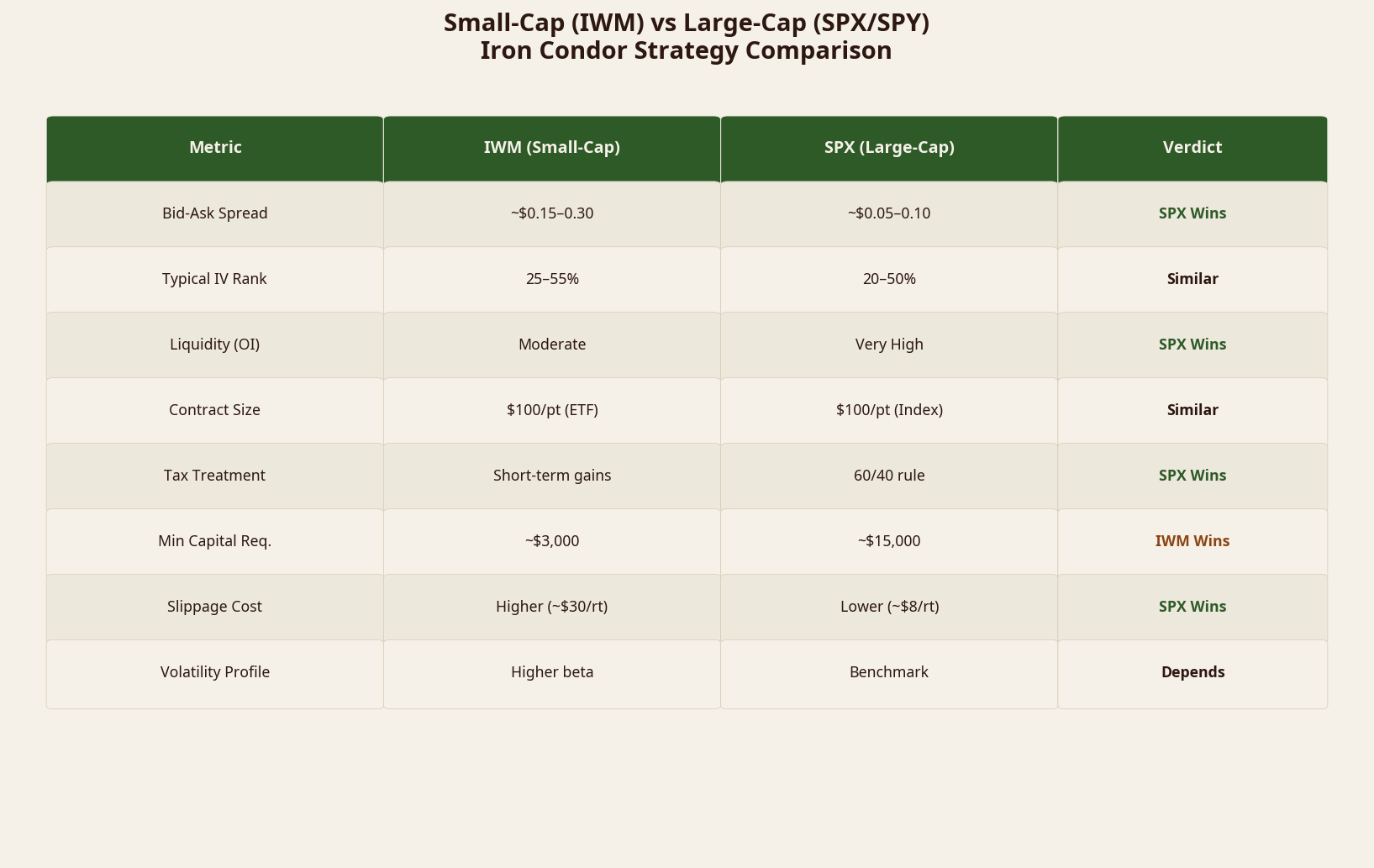
Figure 2: Head-to-head comparison of IWM (small-cap) vs SPX (large-cap) iron condors across key metrics. SPX wins on liquidity, tax treatment, and slippage costs; IWM wins on accessibility for smaller accounts.
Conclusion & Key Takeaways
The choice between trading iron condors on large-cap versus small-cap underlying assets is not a matter of one being inherently "better" than the other. Rather, it's a strategic decision that hinges on understanding and managing the distinct tradeoffs in options liquidity, spread costs, and overall risk profile.
Large-cap options offer unparalleled liquidity, tighter bid-ask spreads, and ease of management, making them ideal for scaling and efficient execution. Small-cap options, while potentially offering higher premiums due to elevated implied volatility, demand a keen awareness of wider spreads, increased slippage, and more volatile price action.
Successful iron condor trading, as with all options strategies, requires meticulous planning, disciplined execution, and robust risk management. By leveraging tools that provide real-time data on IV Rank, liquidity, and Greeks, traders can make informed decisions, whether they choose the stability of a large-cap like SPY or the higher premium potential of a small-cap like IWM.
Always prioritize capital preservation and understand the true costs beyond just the credit received.
Key Takeaways:
- Liquidity is King for Multi-Leg Strategies: Large-cap options (e.g., SPY, AAPL) offer superior liquidity, resulting in tighter bid-ask spreads ($0.01-$0.02) and minimal slippage, crucial for efficient entry and exit of iron condors.
- Small-Cap Premiums Come with a Cost: While small-cap options (e.g., IWM, individual small-caps) often present higher implied volatility and thus fatter premiums, wider bid-ask spreads ($0.10-$0.20+) can significantly erode potential profits and increase transaction costs.
- Always Use Limit Orders: For iron condors, especially on less liquid small-cap options, always use limit orders to control your entry and exit prices and mitigate the impact of wide spreads. Be patient.
- Risk/Reward vs. Probability of Success: Small-caps might offer a better risk/reward ratio on paper, but their higher volatility increases the probability of breaching your short strikes. Large-caps, while offering lower premium per contract, often provide a higher probability of staying within range.
- Position Sizing and Adjustments are Critical: Adhere to strict position sizing (1-2% of capital max risk) and have a clear plan for adjustments or exits if your short strikes are challenged (e.g., delta exceeds 0.35-0.40).
- Avoid Earnings for Standard Condors: Exercise extreme caution or avoid trading iron condors directly into earnings announcements, particularly for small-caps, due to unpredictable gap risk and extreme volatility.
- Leverage Analytics: Utilize tools that provide IV Rank, liquidity metrics, and real-time Greeks (delta, theta, vega) to identify optimal setups and monitor positions effectively, as offered by Volatility Anomaly.
#VolatilityAnomaly · #IVRank · #OptionsTrading · #VRP
You Might Also Like

Volatility Anomaly
Portfolio-Level Hedging for Iron Condor Traders: Using VIX Calls as Insurance
Portfolio-Level Hedging for Iron Condor Traders: Using VIX Calls as Insurance Portfolio-Level Hedging for Iron Condor Traders: Using VIX Calls as Insurance In the world of options trading, strategies like the Iron Condor are highly popular for their ability to generate consistent
Jan 1970

Volatility Anomaly
Gamma Risk in Iron Condors: Understanding the Danger Zone Near Expiration
Gamma Risk in Iron Condors: Understanding the Danger Zone Near Expiration As options traders, we often seek strategies that offer defined risk and a high probability of profit. The iron condor, a staple in many portfolios, perfectly embodies this philosophy. By selling out-of-the
Jan 1970
YOU MIGHT ALSO LIKE
Portfolio-Level Hedging for Iron Condor Traders: Using VIX Calls as Insurance
Portfolio-Level Hedging for Iron Condor Traders: Using VIX Calls as Insurance Portfolio-Level Hedging for Iron…
Read articleGamma Risk in Iron Condors: Understanding the Danger Zone Near Expiration
Gamma Risk in Iron Condors: Understanding the Danger Zone Near Expiration As options traders, we often seek st…
Read articleThe 50% Profit Target Rule: Why Closing Early Improves Your Long-Term Returns
The 50% Profit Target Rule: Why Closing Early Improves Your Long-Term Returns In the dynamic world of options…
Read articleThis article is for educational purposes only and does not constitute financial or investment advice. Options trading involves significant risk of loss and is not suitable for all investors. Past performance is not indicative of future results.